
The Unit Economics of Scaling: Lowering CAC and Increasing LTV for B2B SaaS
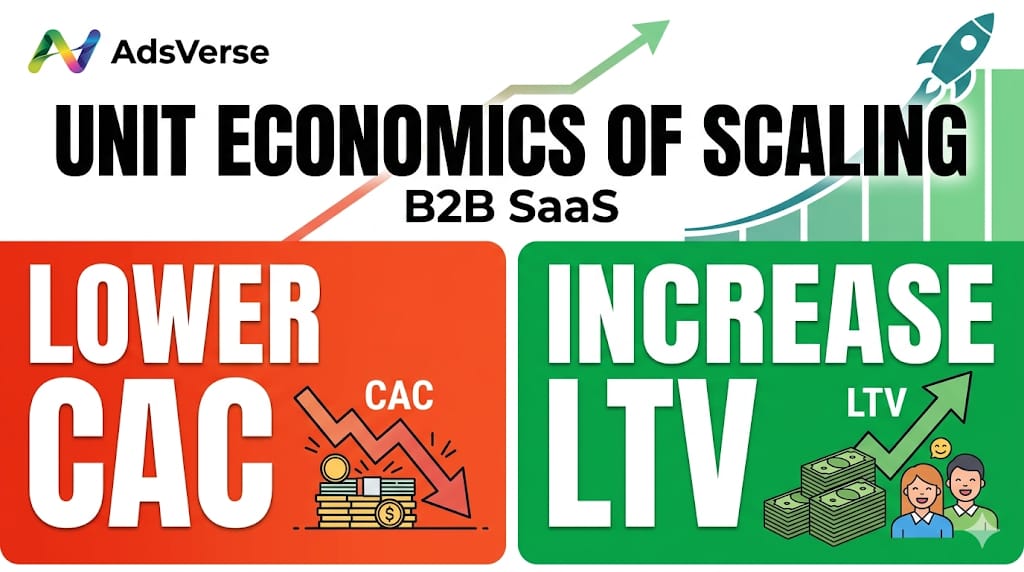
The Illusion of Growth in SaaS: Why Revenue Alone is Misleading
Introduction: The Illusion of Growth in SaaS
In the fast-moving world of B2B SaaS, revenue growth is often treated as the ultimate success metric. Founders celebrate rising MRR, investors chase exponential curves, and teams are pushed to scale aggressively. But beneath this apparent success, many SaaS businesses are silently struggling with a critical flaw — unsustainable unit economics.
Growth without efficiency is not progress; it’s a delayed failure.
Many startups unknowingly fall into the trap of scaling their sales and marketing efforts while ignoring the cost of acquiring and retaining customers. The result? Spending $2 to earn $1 — a model that inevitably collapses.
At AdsVerse, we work with global SaaS founders to shift the focus from “fast growth” to efficient growth, where every dollar spent contributes to long-term profitability.
Understanding the relationship between Customer Acquisition Cost (CAC) and Lifetime Value (LTV) is what separates scalable SaaS giants from short-lived ventures.
1. The LTV/CAC Ratio:
Your North Star Metric
The LTV/CAC ratio is the single most important metric for SaaS sustainability.
A healthy SaaS company should aim for a ratio of at least 3:1. This means for every $1 spent on acquiring a customer, you generate $3 in return over their lifetime.
1:1 ratio → You’re barely surviving
3:1 ratio → Healthy and scalable
5:1 ratio → Potential under-investment in growth
However, many companies miscalculate CAC by ignoring hidden costs like:
Sales team salaries
Marketing tools
Ad spend across channels
Operational overhead
At AdsVerse, we use advanced attribution models to calculate fully-loaded CAC, ensuring you have a clear and honest understanding of your margins.
2. Lowering CAC through Content-Led Growth & Automation
Paid acquisition is becoming increasingly expensive and competitive. Relying solely on ads is no longer sustainable.
To reduce CAC, SaaS companies must invest in Owned Media — assets that generate leads without recurring costs.
Key strategies include:
High-value blog content
Whitepapers & case studies
Webinars & educational funnels
Content-led growth allows you to attract high-intent, qualified leads organically, reducing dependency on paid campaigns.
⚙️ Automation as a Force Multiplier
Manual sales processes are expensive and inefficient at scale.
Instead of relying heavily on SDR teams, modern SaaS companies are adopting:
AI-driven email nurturing
Behavior-based automation
Personalized video outreach
This approach moves leads from awareness → consideration → demo at a fraction of the cost, significantly lowering CAC while maintaining conversion quality.
📈 3. Increasing LTV through Product-Led Expansion
Most companies treat LTV as a retention problem — but in reality, it’s an expansion opportunity.
Top SaaS companies like Slack and Zoom have mastered Product-Led Growth (PLG) by letting the product drive revenue expansion.
How it works:
Analyze user behavior data
Identify usage milestones
Trigger upgrade or cross-sell opportunities
For example:
Increased team usage → Suggest premium plan
Feature adoption → Offer advanced modules
Even a 20% increase in LTV can have a massive impact on valuation — often more than acquiring 50% more new customers.
💰 4. The Payback Period: The Key to Sustainable Scaling
Even with a strong LTV/CAC ratio, your business can fail if your payback period is too long.
What is Payback Period?
It’s the time it takes to recover your customer acquisition cost.
24 months → Risky and cash-heavy
Under 12 months → Healthy and scalable
SaaS companies operate in a delayed revenue model — you spend upfront but recover gradually. If recovery is slow, growth becomes limited by available cash.
How to Reduce Payback Period:
Offer annual upfront pricing discounts
Target high-intent customer segments
Optimize onboarding and activation
At AdsVerse, we focus on shortening this cycle to create a cash-flow-positive growth engine.
🔄 The Flywheel Effect: When Growth Fuels Itself
When your CAC is optimized and your LTV is expanding, something powerful happens:
👉 Your business becomes a self-sustaining flywheel
Faster cash recovery
Reinvestment into marketing
Higher customer value
Compounding growth
This is where SaaS businesses transition from fragile startups to scalable machines.
🎯 Conclusion: Strategy Over Spend
Scaling a SaaS company isn’t about spending more — it’s about spending smarter.
Without strong unit economics, growth becomes a liability instead of an asset.
But when you:
Optimize CAC
Expand LTV
Reduce payback period
You transform your SaaS business into a predictable, efficient growth engine.
At AdsVerse, we help founders build systems that scale sustainably — not just visibly.
👉 Because the goal isn’t just to grow fast…
👉 It’s to grow right.
Join the Conversation
Have insights or questions about this post? We'd love to hear from you. Connect with our team directly or share your thoughts via WhatsApp.
AdsVerse · Digital Excellence 2026